
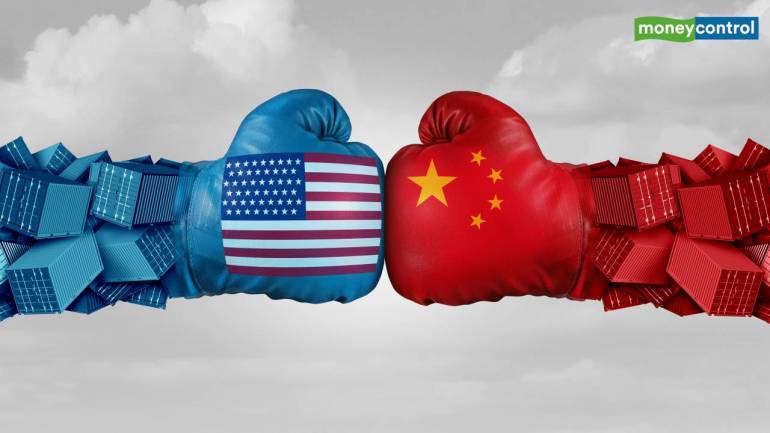
The history of the United States before and after Donald Trump’s administration
The United States signed the Atlantic Charter in the summer of 1941 and through this symbolic act it obtained global leadership from the United Kingdom. It was during this time until 75 years later when Donald Trump was elected as the 45th president of the United States, that almost everyone believed that the United States of America was the ultimate owner of the international regime through its active participation in trade.
Today that active participation is under threat by the United States president, Donald Trump who is unconvinced that active participation in the global economy and the facilitation of trading relationships serve the US interests. Trump’s policies which came after a long and slow but steady economic activity could be a negative decision ultimately for the global economy because it is developed and grown through constant guidance and frequent discretionary initiatives run by strong economies such as the United States. This is why the international forums such as the G7 and G20 remain vital to the global economy, but they too, are dependent on the US leadership.
China is also one of the strongest and growing economies that have become the biggest contributor to the global economy. Stated on a blog post by Pisani-Ferry (2018) this was after China was provided with the best platform to rise in the early 2000s. Therefore, it could have a chance in steering the international system and slowly gain power and influence.
Before Trump’s administration, Obama’s administration negotiated the Trans-Pacific Partnerships which would have been the largest free trade agreement that would positively affect the US economy as well as the global economy. Bilateral agreements were successfully concluded in Peru in 2009, Panama in 2011, Colombia in 2011 and South Korea in 2012. Despite these conclusions, Trump withdrew from it and threatened to withdraw from NAFTA which is the world’s largest trading existing agreement. The United States president strongly believes that there are better bilateral agreements that he could negotiate.
Does active participation and facilitation of trading relationships serve US interests?
President Trump strongly believes that imports are a loss yet if one can take a look at the trade between China and the US, there are potential gains from trade for both countries. China has a comparative advantage in producing diverse manufactures and the US has a comparative advantage in other industries such as the production and exporting of airplanes and information technology, and it is in both countries interests. Take note that this active participation or facilitation of the particular trade relationship by the US serves in the interest of the asset owners and employees of industries that import manufacturers from China. Therefore, if imports tariffs are imposed, the US will lose gains from trade.
From a different angle, the increase of tariffs would lead to higher productivity in the US economy. Through this implementation, employment will be created, which is good because it is the purpose of the measure. Yet, because there is a cycle, higher productivity will lead to higher prices, less consumption, lower incomes and eventually job losses.
In a nutshell, a prolonged trade dispute will end up hurting American businesses and consumers and could even lead to an economic recession.
What major foreign policy changes has Trump made since he has been in office?
During his presidential campaign, Trump’s foreign policy position/values for his presidential term were a bit unclear as he changed it often. At his inauguration, President Trump pledged to embark on a strategy of “America first.” He proceeded to say that the US has made other countries rich while their wealth, strength and confidence has dissipated over the horizon and he assured his people that American can become stronger, healthier and safer by ensuring that people get off of welfare and into the labor market. This way he can rebuild America with American hands and labor, he proclaimed “Buy American and Hire American”. On his quest to make America great again, President Trump has made several changes to America’s foreign trade policy which seem to have started a global trade war.
The Transatlantic Trade and Investment Partnership is a free trade agreement between the EU and the US that is meant to stimulate the economy by standardizing legal regulations. According to the Balance these two economies make up a third of the world’s gross domestic product and if completed, it would be the world’s largest trade agreement. The EU’s investments use 4 million workers on both sides of the Atlantic, this means the greater growth for both parties but the increase in competition for the American and this could potentially harm their industries. But these two countries have their own rules and laws and they struggled to reach common ground in terms of the agricultural procedures.
The North American Free Trade Agreement (NAFTA) is a bilateral trade agreement similar to the TTIP and it is also under President Trump’s firing line. NAFTA is the world’s largest free trade area and it eliminates tariffs between the USA, Canada, and Mexico. Under this agreement, we have seen trade more than triple between Canada, Mexico, and the USA. For the US specifically, the agreement would increase its growth by 0.5% per annum, stimulate foreign direct investment, remove tariffs thus lowering the cost at which the U.S. imports oil from Mexico and create jobs but the estimate jobs gained exceed those lost and there was also a decrease in wages earned. Farmers in Mexico went out of business and the U.S companies degraded their environment just to keep costs low. The deal should be revisited and ratified by each country’s legislation.
The Trans-Pacific Partnership is a trade agreement that was between the US and 11 other countries (Australia, Brunei, Canada, Chile, Japan, Malaysia, Mexico, New Zealand, Peru, Singapore, and Vietnam) but in January of 2017, President Trump withdrew from the TPP and in March of 2018 the 11 countries signed an agreement without the US. Since then, President Trump has shown interest in re-joining the agreement but the rest of the countries do not seem interested in giving in to his demands of a better deal. This agreement consists of shorter patents, compliance with global standards, less tariff protection and the opening up of certain industries. This agreement could have potentially boosted the U. S’s exports and stimulated economic growth but most of the profits gain would go towards the incomes of higher-wage workers.
In March 2018, President Trump’s administration announced a 25% tariff on steel and 10% tariff on aluminum imports because the dependence on other countries for steel and aluminum threatened the U. S’s ability to make their weapons. This has to be a scary realization for the President because he has said he will put America first and countries under their protection should start paying up or tighten up their security. Furthermore, he instructed other countries to do what they must for their wellbeing. If a war is to break out, the American would not even have enough resources to produce their own weapons. In return, China levied a 40% tariff on U.S. auto s and agricultural exports. The U.S. is indebted to China, as of May 2019, the U.S. owes China $1.1 trillion. China keeps investing in U.S debt so that the yuan remains weak in terms of the dollar. China is slowly being more favored by the economics balance of power. One would wonder how dare Trump start a war with his country’s biggest creditor, this is probably because China will not call in its debt all at once because its economy will also suffer.
The World Trade Organization provides global trade rules and its main function is to protect countries when they are engaging in international trade and to resolve any problems that might arise. The organization prevents damaging consequences of trade protectionism to avoid trade wars such as the one that is currently happening between U.S. and China where one country retaliates against another’s tariffs or subsidies by doing the same or worse. In an interview with Bloomberg News, President Trump threatened to withdraw from the WTO as he claims that they treat his country unfairly although some analysis shows that the U.S. has won 90% of its complaints with the WTO.
It is evident that President Trump is adamant to implement protectionism in the U.S., he slowly cutting ties with other countries but is this beneficial for the U.S. or the rest of the economy?
Around 70% of global trade involves the production of goods across multiple countries. If broken at any point, these global value chains will be highly disruptive. As shown above, the US administration has already started implementing a few protectionist measures targeting specific sectors (such as steel and aluminum) or countries (such as China). These new tariffs were initially targeted towards specific industries or countries but due to the retaliation of countries such as China, we are now witnessing a Trade War.
Over the years, the US has prevented economic disputes from turning into trade wars. This helped smaller countries to grow without worry about competition from stronger neighboring countries. Now the economy is faced with much uncertainty because the peacekeeper has turned into the rebel.
On a blog about How the US-China trade war could impact US-EU negotiations Robert Hormats wrote that the global economic order is already troubled due to the great uncertainties surrounding Brexit, intensified US use of sanctions and tariffs against a wide variety of nations, doubts about the legislative future of the United States-Mexico-Canada Agreement (USMCA) on trade, internal stresses and divisions in the EU, and a drastically weakened WTO which will reduce global welfare and GDP growth.
According to the World Bank, the persistent policy uncertainty could hamper growth throughout the global economy and could have adverse effects on investment growth in emerging market and developing economies. If the United States continues to withdraw from world trade, not only will the rest of the world suffer but they will too.
US withdrawal from the global world trade will lead to higher tariffs. Higher import tariffs could cause an increase in the price of imported goods. Global consumer will now have to pay more for goods and services.
Trump’s idea of turning the US into an island with no trade with other economies will be detrimental for the global economy as a whole. Trading takes place so both parties can take advantage of their comparative advantage. Trade has made way for specialization. There will be an overall decrease in productivity because countries will have to change the allocation of resources. There will also be a decrease in investments because of an increase in the uncertainty of future economic conditions. A trade war with these large economies leads to serious consequences on U.S. exporters and labor force.
In conclusion, how a trade dispute will impact economic activity is dependent on several factors such as whether or not the opposition countries will retaliate and how widely spread out the war is, higher import tariffs will certainly increase trade cost which will change the price and quantity of goods produced. Higher trade cost also affects financial flows and credit conditions. Although a trade dispute could temporarily benefit countries that are not involved in the dispute especially if the country provides an import substitute. All economies involved are, in the end, worse off.
Reposted at https://noxolobeda.home.blog/2019/08/02/trump-versus-the-global-economy/
 Karabo's Blog