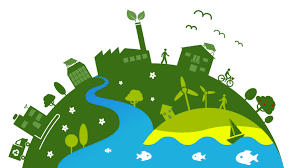
Although climate change comes a long way as far as ancient Greece in terms of its theories, the concern with global climate change is still an issue (Cohen et al, 1998). According to the united nations climatic change is affecting the whole continent. National economies are affected as well as people’s lives, creating an expensive future. Climate change includes changes in weather patterns, rising sea levels and high levels of greenhouse emissions. Without action, the poorest and the most vulnerable will be even more affected. Cohen et al (1998) stated that climate change is one of the important symptoms of unsustainability and global warming is also acknowledged as a problem. Goal 15 of the United Nation for sustainable development include climate action. This entails sustainably managing forests, combating desertification, halt and reversing land degradation and biodiversity loss.
The impact of climate change on sustainable development
Climate change creates a set of multiple stresses which include poverty, unequal access to resources, food security, environmental degradation and risks from natural hazards. Climate change creates costs in the present time and higher cost in the future if it is not well controlled. Catastrophic losses would create even higher costs in the future.
Sustainable development is development that meets the needs of the present without compromising the ability of future generations to meet their own needs, as defined by Yohe et al (2007). The United Nations has introduced sustainable development goals in order to reach a level that is sustainable and better for everyone. These goals address the global challenges the world faces, including those related to poverty, inequality, climate, environmental degradation, prosperity, and peace and justice. The nation’s ability to pursue sustainable development and eventually achieve it can easily be blocked by climate change. This change of weather adds to the list of stressors that are obstacles to obtain ecologic, economic and social objectives that define sustainable development (Yohe et al, 2007).
Swart et al (2013) stated factors that are included in the linkages between climate change and socio-economic problems. The factors include:
Poverty- Climate change affects the poor dismally and disproportionally. This increases the gap in existing development inequalities. The poor are less capable and more vulnerable to any economic changes hence climate change will have a negative impact on the poor. At some stage the poor contribute to climate change as well because of the conversion of forests and marginal lands by poor farmers and the usage of inefficient technologies.
Economic growth and development- Climate change has a negative impact on agriculture, water supply and coastal systems. This will impact economic activity as it depends on these sectors to boost growth.
Health- This is affected in multiple ways as climate change raises certain unforeseen diseases through heat waves, increased weather variability and deterioration of local air quality. The United Nations organisation included that health is hampered with in terms that precipitation could alter the geographical distribution of malaria. There are also health concerns regarding flooding that could possibly bring about diseases such as cholera and diarrheal.
Security- The environment is exposed to climate change effects. Problems such as water shortages arises. This is problematic as water is an important need within communities. This could be a driver of regional political conflicts and tensions.
Access to environmentally sound technologies- Pollution is created through climate change and the effects of this leads to enhanced development and transfer of environmentally sound technologies.
The United Nations Office of the High Representative for the Least Developed Countries, Landlocked Developing Countries and Small Island Developing States (2003) also stated factors that are included in the linkages between climate change and socio-economic problems that could hinder sustainable development. The factors include:
Water resources- Least Developing countries are mostly impacted by changes in climate change as they are only trying to develop alternative ways to improve their standards of living. Climate change will impact these countries significantly in terms of the quality of life. People will be exposed to water stress owing to climate change. One of the other impacts will be on soil moisture and this may pose a problem for future water resources. In these countries where most people are dependent on substantially farming than commercial farming, dry weather and change of weather creates a greater loss.
Agriculture and fisheries- Agricultural sectors and areas may experience negative changes. Agricultural production including access to food is projected to become severely compromised by climate change. Food and security is eventually affected and it poses issues such as malnutrition.
Tourism- Tourists are attracted by beautiful nature and this is important as it serves as a revenue service for the country. Climate change could place tourism at risk. This risks include flood risks, water pollution- related diseases and less tourists will be attracted to the country.
Settlements, industry and infrastructure- Development of a country is based on its infrastructure. Climate change hinders with this as events such as storms, floods and sustained droughts would create a damage to current infrastructure and creating more losses which would lead to higher costs for the future.
The above mentioned factors imply that climate change has an overall negative impact on sustainable development. With the country’s focus to mitigate the risks of climate change and handle the effects, the goals for sustainable development such as climate action, less poverty, zero hunger, good health, proper education, clean water, economic growth and infrastructure innovation become prolonged.
The biggest losers in the wake of severe climate change (developed vs. developing nations).
Climate change has traditionally been seen to have an effect on sea levels, heat waves and general weather patterns but now, climate change is a global reality that undermines sustainable economic growth efforts. With the development and advancement of the global economy through technological advancement, improving systems and an ever-growing population came the issue of pollution and now we are facing global warming.
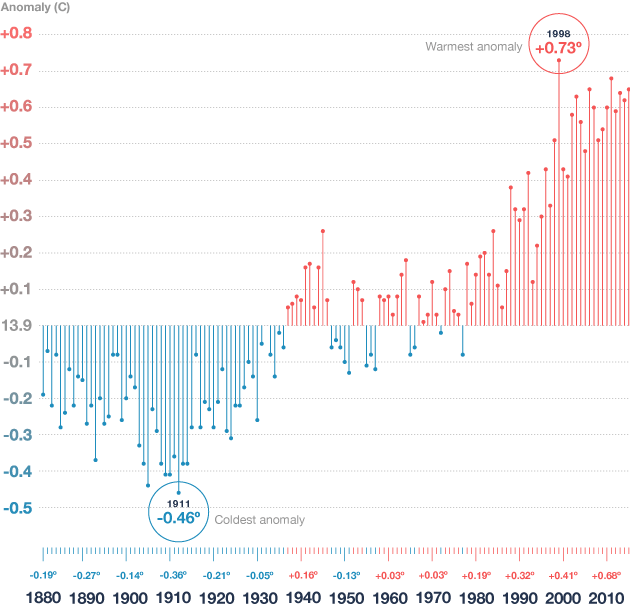
Source: National Centers for Environmental Information
The graph shown above shows how temperature levels have increased over the years. According to Kimberly Amadeo’s article on Climate Change Facts and Effect on the Economy, extreme weather conditions have cost $1.6 trillion (globally) since 1980 and scientist estimate that gross domestic product will decrease by 15% if temperatures were to increase by 2 C.
Smith et al. (2001) research supports this estimation, they concluded that a small increase in global mean temperature (up to 2 °C, measured against 1990 levels) would result in net negative market sector in many developing countries and net positive market sector impacts in many developed countries. Climate change would also increase income inequalities between and within countries. The World Employment and Social Outlook 2018 estimated that climate change threatens 1.2 billion jobs. The industries most at risk are agriculture, fisheries, and forestry
Mr Robert Rubin says climate change is a catastrophic risk that can change the way we live on earth with respect to our economy and society and he emphasized that it is a risk that we cannot take. The long term effects of rising temperature levels are, but not limited to:
- Increased mortality because of rising temperatures
- Higher electricity demands
- Reduced work in exposed environments
- Reduced yield for grains, cotton and oilseeds
- Increased violent and property crimes
- Coastal impacts.
Like any other economic dilemma that exists, climate change affects countries differently. Although there seems to exist a general consensus that climate change adversely affects the economy, that is not the case for all countries. According to a study called “Global warming has increased global inequality”, cooler nations might economically benefit from climate change while warmer nations become less prosperous. It tends to be the most vulnerable communities that get hit the hardest by economic disasters. The general reasoning behind this is that we function better when the weather is “just right”, when it’s neither hot nor cold.
According to a study which was published in Proceedings of the National Academy of Science, between 1961 and 2010 tropical countries like India and Nigeria experienced warming temperatures which significantly slowed their economic growth, while aiding economic growth in cooler countries like Canada and the U.K.
- India
India is a massive country with the population of 1.3 billion people, which is roughly four times as many people as there are in the United States. India is already experiencing a warm climate and a decline in rainfall since the 1950s. Glaciers in the Himalayas and in the Karakoram range have remained stable or even advanced. While other Himalayan glaciers have been retreating over the past century. The loss of snow cover over the Himalayas threatens the stability of the glacier-fed rivers.
India is also close to the equator, the rise in sea levels and storms will impact their agricultural sector, decrease water quality and possibly cause an increase in health hazards. India is expected to face major health impacts, with child stunting projected to increase by 35% by 2030. Climate change also threatens food prices. Food security is also under serious threat.
2. Australia
Australia also has a warm climate with high annual rainfall and high risks of fire. Between 1844 and 2010, extreme heat killed more than 5,300 Australians. Many Australians have lost their loves due to heat-related causes, and that could get even worse. Majority of Australia’s population resides along the coasts thus Australia is vulnerable to the effects of global warming.
3.Nigeria
Nigeria borders Niger to the south and sits along the Atlantic coast. It is Nigeria’s population, economic structure, agricultural sector, geography and climate that makes it prone to adverse effects of climate change. Although Nigeria has a strong economy as compared to other countries in the Sub-Saharan region, more parts of its economy is linked to activities that are highly sensitive towards climate changes and this endangers the lively-hood of most of the population. Nigeria has seen an increase in drought, irregular rainfalls and over flooding.
Figure 2: How big economies will be impacted by climate change
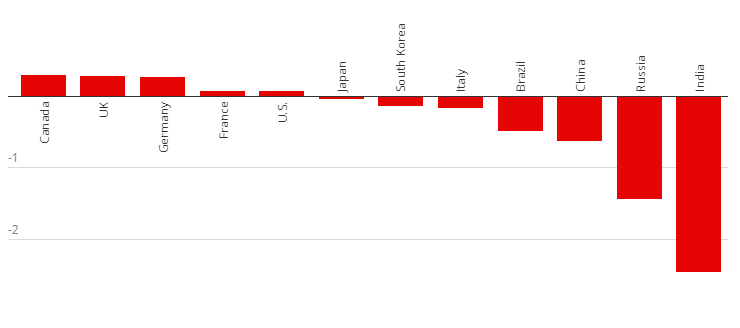
Source : Moody’s Analytics
4. Canada
Assuming a one-degree rise, Moody’s forecasts a Canadian economy that’s about the same in 2048 as it would otherwise be. If the impact is 1.9 degrees, the GDP impact inches up to 0.16 per cent. At 2.4 degrees, it’s 0.1 per cent. And if the temperature rises by four degrees in the next three decades, Canada’s economy is projected to be 0.3 per cent greater than it would otherwise have been.
5. United States
The forecast for the U.S. is a bit of a wash, as the most optimistic temperature increase would hurt the U.S. economy to the tune of 0.9 per cent, while the most dire would see a 0.8 per cent expansion. “But it would be too simplistic to say that climate change does not hurt the U.S.,” Moody’s said, noting that some parts of the country would be badly hurt by disasters and rising sea levels, whereas others would benefit.
How the Green Economy movement has developed globally
The transition to a global Green Economy still has a long way to go, but several countries are already actively demonstrating leadership by adopting national “green growth” economic strategies.
The Middle East and North Africa (MENA) region has been the topic and in the spotlight regarding investments in renewable energy technologies. Both national governments and international donors have started to view renewables as an important solution for the energy and development challenges in the region and have successfully implemented the green economy.
Within the region, the country Morocco stands out. It’s been reported that the country imported “more than 95 per cent of its energy in 2011, and its energy demand is expected to triple by 2030” (MEMEE 2011). This illustrates that the country Morocco strongly depends on imports. In addition, the country is already benefitting by reducing unemployment through job creation by the private sector as the country suffers from high unemployment. The private sector is also currently benefitting through these new developments and momentum in the private sector as Morocco’s manufacturing base is relatively low, industrial competitiveness is deficient and entrepreneurship is limited.
In addition to some of the other countries globally that have implemented the green economy strategy, here are some of the successful examples of countries who have experienced increased growth or productivity in a sustainable manner:
- The Republic of Korea has implemented a national strategy and a five-year plan for green growth, whereby the country has allocated a certain percentage of their gross domestic product to investment in several “green sectors such as renewable energy, energy efficiency, clean technology and water”. I addition, the government is also involved in terms of opening a Global Green Growth Institute which aims to help developing countries develop green growth strategies.
- Apparently in China, the country now invests more than any other country in renewable energy. The investment has grew by over 60 percent since 2010. This growth is explained to be driven by a “national policy that sees clean energy as a major market in the near future, and one in which China wants to gain a competitive edge”.
- Lastly, Namibia is doing quite well in managing its natural resources to generate economic, social, and environmental benefits. Local communities across the country are granted the right to use and capitalize on the natural resources. As result of the economic incentive to sustainably manage these areas, unemployment is being reduced as employment is created for thousands of Namibians in rural areas.
In conclusion, it is alarming how a green economy will result in a better, successful, productive and sustainable growth. Developing countries should be encouraged to begin to set aside specific funds which can focus on “climate finance” from their respective annual budgets in order to prevent worsening the current climate crises we are witnessing.
It is, in addition, evident that more still needs to be done in terms of climate governance and policy globally. However, regardless of the current global economic outlook, and the continuous growing risks from climate change, poverty, natural resource depletion and environmental degradation, there is still an opportunity for a bright green economic future. In conclusion and addition to the above study, it is suggested that intense reorientation of investments are implemented to reduce environmental risks and ecological scarcities. In addition, new regulatory frameworks with management criteria and performance indicators are also needed to guide these investments so that they contribute to green economic growth.
South Africa is a rapidly industrializing country that has a high rate of urbanization, and a significant per capita carbon footprint; compared to other countries in the world. It is therefore important that country’s economy is towards developing value-adding industries, as well as investing in energy efficiency and low-carbon energy supply, green innovation and natural resources management. These investments will benefit the country and the economy as well, moreover, delivering socioeconomic benefits over time. New opportunities will unfold of “developing skills, creating jobs and developing businesses, while mitigating climate change, and maintaining and enhancing ecosystem services needed for economic activity and all life”. It is evident that the transition to a green economy demands an inclusive approach through the building of new partnerships, with cooperation, as well as participation and action from all members and sectors of society. A shared vision of the green economy and “the future we want” will provide the advocacy that is needed to mobilize joint action. Collective and shared efforts from all members of society will be needed for more equitable, resource efficient and low carbon economy that provides a pathway to sustainable development.
Reposted at https://noxolobeda.home.blog/2019/10/21/climate-change-an-economic-reality/
 Karabo's Blog