Be yourself; Everyone else is already taken.
— Oscar Wilde.
This is the first post on my new blog. I’m just getting this new blog going, so stay tuned for more. Subscribe below to get notified when I post new updates.
Be yourself; Everyone else is already taken.
— Oscar Wilde.
This is the first post on my new blog. I’m just getting this new blog going, so stay tuned for more. Subscribe below to get notified when I post new updates.
Although climate change comes a long way as far as ancient Greece in terms of its theories, the concern with global climate change is still an issue (Cohen et al, 1998). According to the united nations climatic change is affecting the whole continent. National economies are affected as well as people’s lives, creating an expensive future. Climate change includes changes in weather patterns, rising sea levels and high levels of greenhouse emissions. Without action, the poorest and the most vulnerable will be even more affected. Cohen et al (1998) stated that climate change is one of the important symptoms of unsustainability and global warming is also acknowledged as a problem. Goal 15 of the United Nation for sustainable development include climate action. This entails sustainably managing forests, combating desertification, halt and reversing land degradation and biodiversity loss.
The impact of climate change on sustainable development
Climate change creates a set of multiple stresses which include poverty, unequal access to resources, food security, environmental degradation and risks from natural hazards. Climate change creates costs in the present time and higher cost in the future if it is not well controlled. Catastrophic losses would create even higher costs in the future.
Sustainable development is development that meets the needs of the present without compromising the ability of future generations to meet their own needs, as defined by Yohe et al (2007). The United Nations has introduced sustainable development goals in order to reach a level that is sustainable and better for everyone. These goals address the global challenges the world faces, including those related to poverty, inequality, climate, environmental degradation, prosperity, and peace and justice. The nation’s ability to pursue sustainable development and eventually achieve it can easily be blocked by climate change. This change of weather adds to the list of stressors that are obstacles to obtain ecologic, economic and social objectives that define sustainable development (Yohe et al, 2007).
Swart et al (2013) stated factors that are included in the linkages between climate change and socio-economic problems. The factors include:
Poverty- Climate change affects the poor dismally and disproportionally. This increases the gap in existing development inequalities. The poor are less capable and more vulnerable to any economic changes hence climate change will have a negative impact on the poor. At some stage the poor contribute to climate change as well because of the conversion of forests and marginal lands by poor farmers and the usage of inefficient technologies.
Economic growth and development- Climate change has a negative impact on agriculture, water supply and coastal systems. This will impact economic activity as it depends on these sectors to boost growth.
Health- This is affected in multiple ways as climate change raises certain unforeseen diseases through heat waves, increased weather variability and deterioration of local air quality. The United Nations organisation included that health is hampered with in terms that precipitation could alter the geographical distribution of malaria. There are also health concerns regarding flooding that could possibly bring about diseases such as cholera and diarrheal.
Security- The environment is exposed to climate change effects. Problems such as water shortages arises. This is problematic as water is an important need within communities. This could be a driver of regional political conflicts and tensions.
Access to environmentally sound technologies- Pollution is created through climate change and the effects of this leads to enhanced development and transfer of environmentally sound technologies.
The United Nations Office of the High Representative for the Least Developed Countries, Landlocked Developing Countries and Small Island Developing States (2003) also stated factors that are included in the linkages between climate change and socio-economic problems that could hinder sustainable development. The factors include:
Water resources- Least Developing countries are mostly impacted by changes in climate change as they are only trying to develop alternative ways to improve their standards of living. Climate change will impact these countries significantly in terms of the quality of life. People will be exposed to water stress owing to climate change. One of the other impacts will be on soil moisture and this may pose a problem for future water resources. In these countries where most people are dependent on substantially farming than commercial farming, dry weather and change of weather creates a greater loss.
Agriculture and fisheries- Agricultural sectors and areas may experience negative changes. Agricultural production including access to food is projected to become severely compromised by climate change. Food and security is eventually affected and it poses issues such as malnutrition.
Tourism- Tourists are attracted by beautiful nature and this is important as it serves as a revenue service for the country. Climate change could place tourism at risk. This risks include flood risks, water pollution- related diseases and less tourists will be attracted to the country.
Settlements, industry and infrastructure- Development of a country is based on its infrastructure. Climate change hinders with this as events such as storms, floods and sustained droughts would create a damage to current infrastructure and creating more losses which would lead to higher costs for the future.
The above mentioned factors imply that climate change has an overall negative impact on sustainable development. With the country’s focus to mitigate the risks of climate change and handle the effects, the goals for sustainable development such as climate action, less poverty, zero hunger, good health, proper education, clean water, economic growth and infrastructure innovation become prolonged.
The biggest losers in the wake of severe climate change (developed vs. developing nations).
Climate change has traditionally been seen to have an effect on sea levels, heat waves and general weather patterns but now, climate change is a global reality that undermines sustainable economic growth efforts. With the development and advancement of the global economy through technological advancement, improving systems and an ever-growing population came the issue of pollution and now we are facing global warming.
Source: National Centers for Environmental Information
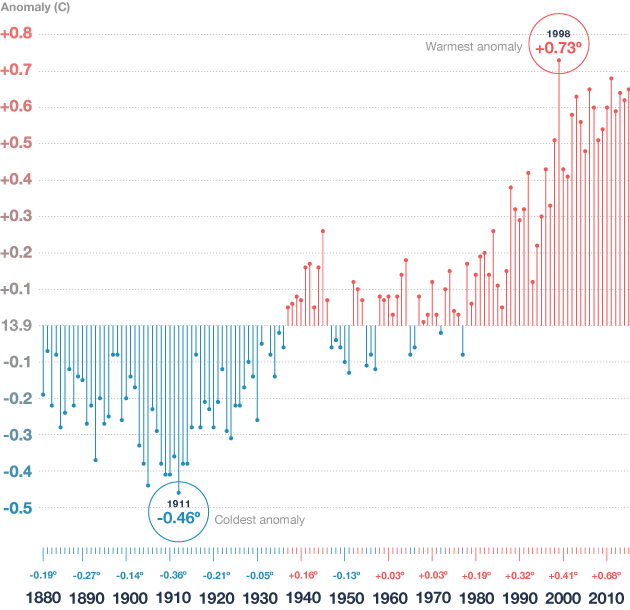
The graph shown above shows how temperature levels have increased over the years. According to Kimberly Amadeo’s article on Climate Change Facts and Effect on the Economy, extreme weather conditions have cost $1.6 trillion (globally) since 1980 and scientist estimate that gross domestic product will decrease by 15% if temperatures were to increase by 2 C.
Smith et al. (2001) research supports this estimation, they concluded that a small increase in global mean temperature (up to 2 °C, measured against 1990 levels) would result in net negative market sector in many developing countries and net positive market sector impacts in many developed countries. Climate change would also increase income inequalities between and within countries. The World Employment and Social Outlook 2018 estimated that climate change threatens 1.2 billion jobs. The industries most at risk are agriculture, fisheries, and forestry
Mr Robert Rubin says climate change is a catastrophic risk that can change the way we live on earth with respect to our economy and society and he emphasized that it is a risk that we cannot take. The long term effects of rising temperature levels are, but not limited to:
Like any other economic dilemma that exists, climate change affects countries differently. Although there seems to exist a general consensus that climate change adversely affects the economy, that is not the case for all countries. According to a study called “Global warming has increased global inequality”, cooler nations might economically benefit from climate change while warmer nations become less prosperous. It tends to be the most vulnerable communities that get hit the hardest by economic disasters. The general reasoning behind this is that we function better when the weather is “just right”, when it’s neither hot nor cold.
According to a study which was published in Proceedings of the National Academy of Science, between 1961 and 2010 tropical countries like India and Nigeria experienced warming temperatures which significantly slowed their economic growth, while aiding economic growth in cooler countries like Canada and the U.K.
India is a massive country with the population of 1.3 billion people, which is roughly four times as many people as there are in the United States. India is already experiencing a warm climate and a decline in rainfall since the 1950s. Glaciers in the Himalayas and in the Karakoram range have remained stable or even advanced. While other Himalayan glaciers have been retreating over the past century. The loss of snow cover over the Himalayas threatens the stability of the glacier-fed rivers.
India is also close to the equator, the rise in sea levels and storms will impact their agricultural sector, decrease water quality and possibly cause an increase in health hazards. India is expected to face major health impacts, with child stunting projected to increase by 35% by 2030. Climate change also threatens food prices. Food security is also under serious threat.
2. Australia
Australia also has a warm climate with high annual rainfall and high risks of fire. Between 1844 and 2010, extreme heat killed more than 5,300 Australians. Many Australians have lost their loves due to heat-related causes, and that could get even worse. Majority of Australia’s population resides along the coasts thus Australia is vulnerable to the effects of global warming.
3.Nigeria
Nigeria borders Niger to the south and sits along the Atlantic coast. It is Nigeria’s population, economic structure, agricultural sector, geography and climate that makes it prone to adverse effects of climate change. Although Nigeria has a strong economy as compared to other countries in the Sub-Saharan region, more parts of its economy is linked to activities that are highly sensitive towards climate changes and this endangers the lively-hood of most of the population. Nigeria has seen an increase in drought, irregular rainfalls and over flooding.
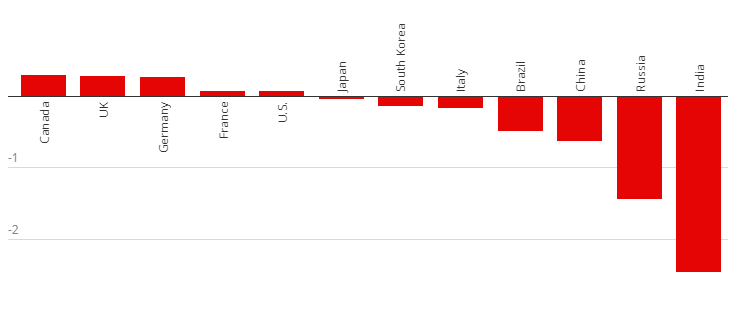
Figure 2: How big economies will be impacted by climate change
Source : Moody’s Analytics
4. Canada
Assuming a one-degree rise, Moody’s forecasts a Canadian economy that’s about the same in 2048 as it would otherwise be. If the impact is 1.9 degrees, the GDP impact inches up to 0.16 per cent. At 2.4 degrees, it’s 0.1 per cent. And if the temperature rises by four degrees in the next three decades, Canada’s economy is projected to be 0.3 per cent greater than it would otherwise have been.
5. United States
The forecast for the U.S. is a bit of a wash, as the most optimistic temperature increase would hurt the U.S. economy to the tune of 0.9 per cent, while the most dire would see a 0.8 per cent expansion. “But it would be too simplistic to say that climate change does not hurt the U.S.,” Moody’s said, noting that some parts of the country would be badly hurt by disasters and rising sea levels, whereas others would benefit.
How the Green Economy movement has developed globally
The transition to a global Green Economy still has a long way to go, but several countries are already actively demonstrating leadership by adopting national “green growth” economic strategies.
The Middle East and North Africa (MENA) region has been the topic and in the spotlight regarding investments in renewable energy technologies. Both national governments and international donors have started to view renewables as an important solution for the energy and development challenges in the region and have successfully implemented the green economy.
Within the region, the country Morocco stands out. It’s been reported that the country imported “more than 95 per cent of its energy in 2011, and its energy demand is expected to triple by 2030” (MEMEE 2011). This illustrates that the country Morocco strongly depends on imports. In addition, the country is already benefitting by reducing unemployment through job creation by the private sector as the country suffers from high unemployment. The private sector is also currently benefitting through these new developments and momentum in the private sector as Morocco’s manufacturing base is relatively low, industrial competitiveness is deficient and entrepreneurship is limited.
In addition to some of the other countries globally that have implemented the green economy strategy, here are some of the successful examples of countries who have experienced increased growth or productivity in a sustainable manner:
In conclusion, it is alarming how a green economy will result in a better, successful, productive and sustainable growth. Developing countries should be encouraged to begin to set aside specific funds which can focus on “climate finance” from their respective annual budgets in order to prevent worsening the current climate crises we are witnessing.
It is, in addition, evident that more still needs to be done in terms of climate governance and policy globally. However, regardless of the current global economic outlook, and the continuous growing risks from climate change, poverty, natural resource depletion and environmental degradation, there is still an opportunity for a bright green economic future. In conclusion and addition to the above study, it is suggested that intense reorientation of investments are implemented to reduce environmental risks and ecological scarcities. In addition, new regulatory frameworks with management criteria and performance indicators are also needed to guide these investments so that they contribute to green economic growth.
South Africa is a rapidly industrializing country that has a high rate of urbanization, and a significant per capita carbon footprint; compared to other countries in the world. It is therefore important that country’s economy is towards developing value-adding industries, as well as investing in energy efficiency and low-carbon energy supply, green innovation and natural resources management. These investments will benefit the country and the economy as well, moreover, delivering socioeconomic benefits over time. New opportunities will unfold of “developing skills, creating jobs and developing businesses, while mitigating climate change, and maintaining and enhancing ecosystem services needed for economic activity and all life”. It is evident that the transition to a green economy demands an inclusive approach through the building of new partnerships, with cooperation, as well as participation and action from all members and sectors of society. A shared vision of the green economy and “the future we want” will provide the advocacy that is needed to mobilize joint action. Collective and shared efforts from all members of society will be needed for more equitable, resource efficient and low carbon economy that provides a pathway to sustainable development.
Reposted at https://noxolobeda.home.blog/2019/10/21/climate-change-an-economic-reality/
The World Economic Forum has released the Global Competitiveness Report for the year 2019 and it seems the world economy is still locked in a cycle of low or flat productivity growth despite the injection of more than $10 trillion by central banks. The slow growth in the world economy is due to the congested international governance system and trade tension as we have witnessed between the two main economic players, United States and China.
On the 9th of October, Moneyweb posted an article reporting on South Africa’s recent rise in competiveness rankings. South Africa’s recent gain in momentum is largely due to changes in the political sphere and consistent strength in the financial hub, developed markets and its size as well as transport infrastructure. Although South Africa has made some improvements in the global economy, the nation’s domestic growth is still of concern. It is worrisome that we still rank poorly in terms of healthcare systems, security and labour market flexibility.
South Africa is characterized by a variety of private freedom, combined with centralized economic planning and government regulation. Although South Africa is a growing economy, it is one of the largest economies in South Africa with China, Germany and the United States as its top 3 trading partners. One of South Africa’s strengths is it regional/ continental economic power as well as the comfortable legal environment it provides its investors.
South Africa is also very rich in natural resources, mainly exporting precious stones & metals, ores, and oil & mineral fuels. Yet the economic growth of South Africa still remains lacklustre, one may ask if South Africa’s government is efficiently using the country’s resources.
Figure 1: Monetary Fiscal Policy in South Africa associated with GDP from 1994 to 2015
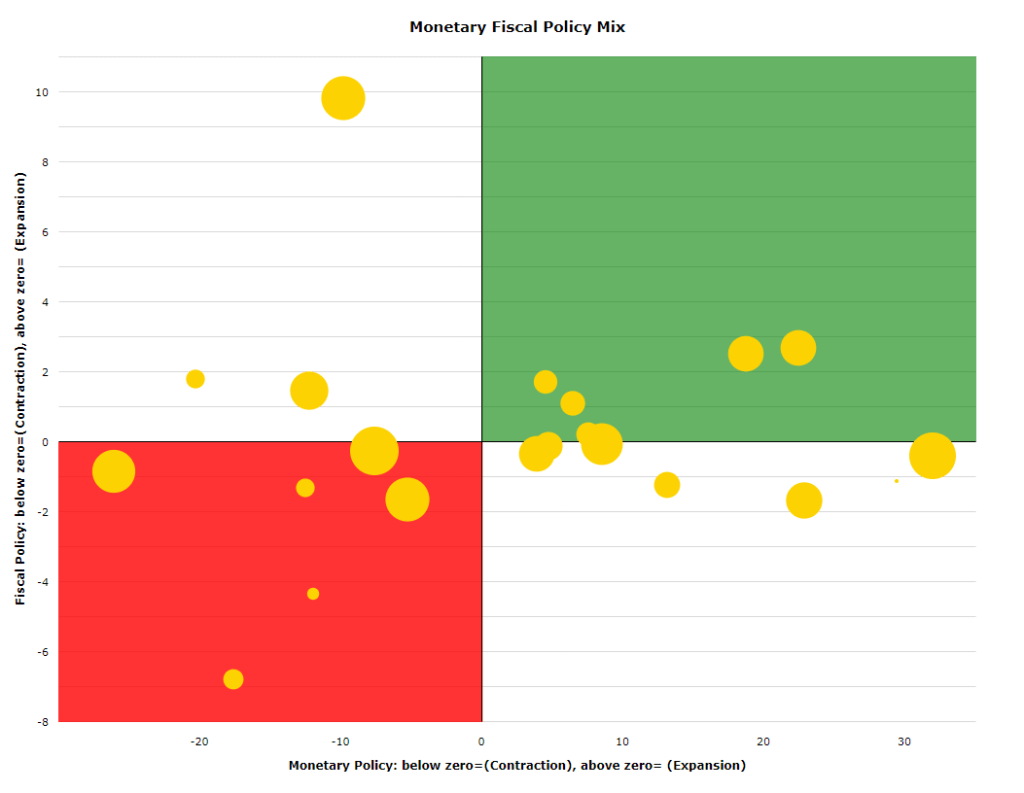
Fiscal policy is used to stimulate economic and social development by the National Treasury, through the implementation of a policy stance that ensures a sense of balance between taxation, expenditure and borrowing that is consistent with sustainable growth. Over the years, we have seen a rise in government debt and the country’s deficit levels. Government expenditure has also increased significantly. The South Africa Reserve Bank (SARB) is responsible controlling the countries money supply.
In order to stimulate the economy, it is essential to have complementary monetary and fiscal policy goals. The graph depicted above shows that South Africa’s monetary and fiscal policy are not always coordinated. Contradicting policy goals have detrimental effects on the economy’s growth. The SARB’S main focus it inflation targeting while the National Treasury focuses on economic growth. Monetary and fiscal policies are ineffective if they are working towards different directions. Maybe the first problem that we’re facing as the economy is that our supplier of money is only concerned with keeping prices constant over time. The South African Market Insights suggested that The National Treasury and the Reserve Bank discuss the overall aim for South Africa in the next few years and coordinated policies in order to take advantage of favourable economic situations.
There is no “one size fits all” approach to economic growth, it is important to have policymakers that are willing to tailor policies to fit the needs of the economy. The policymakers in the euro area, United Kingdome and Japan aggressively cut central bank interest rates and implemented a variety of untested and unconventional monetary policies when the global financial crises occurred. In so doing, they increased the liquidity of banks and other financial intermediaries and later increasing the central bank’s balance sheet. The unconventional policies restored the functioning of financial markets and prevented further financial distress.
According to GlobalEdge, South Africa has a country risk rating of B and a business rating climate of A4. Country risk ratings measures the degree to which political and economic unrest affect the securities of issuers doing business in a particular country. Although the country risk rating is acceptable, the political and economic uncertainties and occasionally difficult business environment have influenced South Africa’s rating. The business environment is acceptable but corporate financial information is sometimes neither readily available nor sufficiently reliable. Debt collection is also inefficient and the institutional framework has shortcomings.
According to the World Bank, “South Africa’s current economic rebound could be short-lived if the fundamental factors undermining its growth potential are not addressed”. South Africa’s main issues are poverty and inequality, high unemployment rate, transport and energy infrastructure shortcomings, a highly volatile currency and rising inflationary pressures. South Africa has shifted from racial inequality to income inequality. Inequality leads to hunger poverty, poor healthcare and an overall increase in dependence on the state.
How can the policymakers improve South Africa’s economic growth?
Macroeconomic stability
The government needs to maintain macroeconomic stability. The National Treasury and the South Africa Reserve Bank should work towards a shared goal to ensure that macroeconomic objectives are met. Contractionary macroeconomic policies will not pursue inclusive growth and job creation with. The government has to increase aggregate demand and support supply capacity if it is to achieve economic development.
Decrease government debt and curb government spending
The government has to mobilise resources better. They can invest in municipal bonds and pension funds.
State owned enterprises
State-owned enterprises should be kept efficient.
Corruption
Good governance is essential. Policymakers need to make sure there is complete judicial independence, free from political interference.
Grow value chain
The government should focus on growing the sectors that are boosting South Africa’s growth in order to grow and diversify exports
Human capital
The government has to create an economy that is conducive for the growth and development of human capital. Human capital is at the core of development; a capable workforce will lead to a capable economy. Government has to invest in skills development programmes. The government also needs to work on improving labour market flexibility by reducing trade union power, encouraging part-time work, and encouraging new business start-ups.
In conclusion, South Africa is a well-resourced country and it seems the problems lies within the allocation and efficient use of these resources. Our lackluster growth is indeed a cause for concern. Our global ranking is of no good to us if it does not mean better stands of living for the population at large. The government needs to work hard towards dismantling inequality and alleviating poverty.

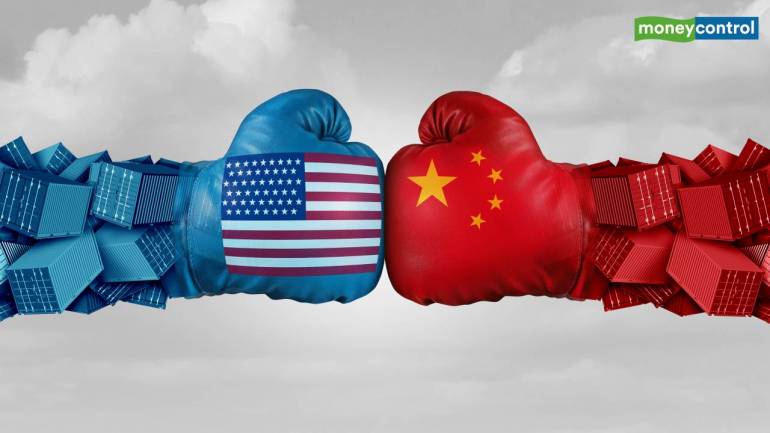
The history of the United States before and after Donald Trump’s administration
The United States signed the Atlantic Charter in the summer of 1941 and through this symbolic act it obtained global leadership from the United Kingdom. It was during this time until 75 years later when Donald Trump was elected as the 45th president of the United States, that almost everyone believed that the United States of America was the ultimate owner of the international regime through its active participation in trade.
Today that active participation is under threat by the United States president, Donald Trump who is unconvinced that active participation in the global economy and the facilitation of trading relationships serve the US interests. Trump’s policies which came after a long and slow but steady economic activity could be a negative decision ultimately for the global economy because it is developed and grown through constant guidance and frequent discretionary initiatives run by strong economies such as the United States. This is why the international forums such as the G7 and G20 remain vital to the global economy, but they too, are dependent on the US leadership.
China is also one of the strongest and growing economies that have become the biggest contributor to the global economy. Stated on a blog post by Pisani-Ferry (2018) this was after China was provided with the best platform to rise in the early 2000s. Therefore, it could have a chance in steering the international system and slowly gain power and influence.
Before Trump’s administration, Obama’s administration negotiated the Trans-Pacific Partnerships which would have been the largest free trade agreement that would positively affect the US economy as well as the global economy. Bilateral agreements were successfully concluded in Peru in 2009, Panama in 2011, Colombia in 2011 and South Korea in 2012. Despite these conclusions, Trump withdrew from it and threatened to withdraw from NAFTA which is the world’s largest trading existing agreement. The United States president strongly believes that there are better bilateral agreements that he could negotiate.
Does active participation and facilitation of trading relationships serve US interests?
President Trump strongly believes that imports are a loss yet if one can take a look at the trade between China and the US, there are potential gains from trade for both countries. China has a comparative advantage in producing diverse manufactures and the US has a comparative advantage in other industries such as the production and exporting of airplanes and information technology, and it is in both countries interests. Take note that this active participation or facilitation of the particular trade relationship by the US serves in the interest of the asset owners and employees of industries that import manufacturers from China. Therefore, if imports tariffs are imposed, the US will lose gains from trade.
From a different angle, the increase of tariffs would lead to higher productivity in the US economy. Through this implementation, employment will be created, which is good because it is the purpose of the measure. Yet, because there is a cycle, higher productivity will lead to higher prices, less consumption, lower incomes and eventually job losses.
In a nutshell, a prolonged trade dispute will end up hurting American businesses and consumers and could even lead to an economic recession.
What major foreign policy changes has Trump made since he has been in office?
During his presidential campaign, Trump’s foreign policy position/values for his presidential term were a bit unclear as he changed it often. At his inauguration, President Trump pledged to embark on a strategy of “America first.” He proceeded to say that the US has made other countries rich while their wealth, strength and confidence has dissipated over the horizon and he assured his people that American can become stronger, healthier and safer by ensuring that people get off of welfare and into the labor market. This way he can rebuild America with American hands and labor, he proclaimed “Buy American and Hire American”. On his quest to make America great again, President Trump has made several changes to America’s foreign trade policy which seem to have started a global trade war.
The Transatlantic Trade and Investment Partnership is a free trade agreement between the EU and the US that is meant to stimulate the economy by standardizing legal regulations. According to the Balance these two economies make up a third of the world’s gross domestic product and if completed, it would be the world’s largest trade agreement. The EU’s investments use 4 million workers on both sides of the Atlantic, this means the greater growth for both parties but the increase in competition for the American and this could potentially harm their industries. But these two countries have their own rules and laws and they struggled to reach common ground in terms of the agricultural procedures.
The North American Free Trade Agreement (NAFTA) is a bilateral trade agreement similar to the TTIP and it is also under President Trump’s firing line. NAFTA is the world’s largest free trade area and it eliminates tariffs between the USA, Canada, and Mexico. Under this agreement, we have seen trade more than triple between Canada, Mexico, and the USA. For the US specifically, the agreement would increase its growth by 0.5% per annum, stimulate foreign direct investment, remove tariffs thus lowering the cost at which the U.S. imports oil from Mexico and create jobs but the estimate jobs gained exceed those lost and there was also a decrease in wages earned. Farmers in Mexico went out of business and the U.S companies degraded their environment just to keep costs low. The deal should be revisited and ratified by each country’s legislation.
The Trans-Pacific Partnership is a trade agreement that was between the US and 11 other countries (Australia, Brunei, Canada, Chile, Japan, Malaysia, Mexico, New Zealand, Peru, Singapore, and Vietnam) but in January of 2017, President Trump withdrew from the TPP and in March of 2018 the 11 countries signed an agreement without the US. Since then, President Trump has shown interest in re-joining the agreement but the rest of the countries do not seem interested in giving in to his demands of a better deal. This agreement consists of shorter patents, compliance with global standards, less tariff protection and the opening up of certain industries. This agreement could have potentially boosted the U. S’s exports and stimulated economic growth but most of the profits gain would go towards the incomes of higher-wage workers.
In March 2018, President Trump’s administration announced a 25% tariff on steel and 10% tariff on aluminum imports because the dependence on other countries for steel and aluminum threatened the U. S’s ability to make their weapons. This has to be a scary realization for the President because he has said he will put America first and countries under their protection should start paying up or tighten up their security. Furthermore, he instructed other countries to do what they must for their wellbeing. If a war is to break out, the American would not even have enough resources to produce their own weapons. In return, China levied a 40% tariff on U.S. auto s and agricultural exports. The U.S. is indebted to China, as of May 2019, the U.S. owes China $1.1 trillion. China keeps investing in U.S debt so that the yuan remains weak in terms of the dollar. China is slowly being more favored by the economics balance of power. One would wonder how dare Trump start a war with his country’s biggest creditor, this is probably because China will not call in its debt all at once because its economy will also suffer.
The World Trade Organization provides global trade rules and its main function is to protect countries when they are engaging in international trade and to resolve any problems that might arise. The organization prevents damaging consequences of trade protectionism to avoid trade wars such as the one that is currently happening between U.S. and China where one country retaliates against another’s tariffs or subsidies by doing the same or worse. In an interview with Bloomberg News, President Trump threatened to withdraw from the WTO as he claims that they treat his country unfairly although some analysis shows that the U.S. has won 90% of its complaints with the WTO.
It is evident that President Trump is adamant to implement protectionism in the U.S., he slowly cutting ties with other countries but is this beneficial for the U.S. or the rest of the economy?
Around 70% of global trade involves the production of goods across multiple countries. If broken at any point, these global value chains will be highly disruptive. As shown above, the US administration has already started implementing a few protectionist measures targeting specific sectors (such as steel and aluminum) or countries (such as China). These new tariffs were initially targeted towards specific industries or countries but due to the retaliation of countries such as China, we are now witnessing a Trade War.
Over the years, the US has prevented economic disputes from turning into trade wars. This helped smaller countries to grow without worry about competition from stronger neighboring countries. Now the economy is faced with much uncertainty because the peacekeeper has turned into the rebel.
On a blog about How the US-China trade war could impact US-EU negotiations Robert Hormats wrote that the global economic order is already troubled due to the great uncertainties surrounding Brexit, intensified US use of sanctions and tariffs against a wide variety of nations, doubts about the legislative future of the United States-Mexico-Canada Agreement (USMCA) on trade, internal stresses and divisions in the EU, and a drastically weakened WTO which will reduce global welfare and GDP growth.
According to the World Bank, the persistent policy uncertainty could hamper growth throughout the global economy and could have adverse effects on investment growth in emerging market and developing economies. If the United States continues to withdraw from world trade, not only will the rest of the world suffer but they will too.
US withdrawal from the global world trade will lead to higher tariffs. Higher import tariffs could cause an increase in the price of imported goods. Global consumer will now have to pay more for goods and services.
Trump’s idea of turning the US into an island with no trade with other economies will be detrimental for the global economy as a whole. Trading takes place so both parties can take advantage of their comparative advantage. Trade has made way for specialization. There will be an overall decrease in productivity because countries will have to change the allocation of resources. There will also be a decrease in investments because of an increase in the uncertainty of future economic conditions. A trade war with these large economies leads to serious consequences on U.S. exporters and labor force.
In conclusion, how a trade dispute will impact economic activity is dependent on several factors such as whether or not the opposition countries will retaliate and how widely spread out the war is, higher import tariffs will certainly increase trade cost which will change the price and quantity of goods produced. Higher trade cost also affects financial flows and credit conditions. Although a trade dispute could temporarily benefit countries that are not involved in the dispute especially if the country provides an import substitute. All economies involved are, in the end, worse off.
Reposted at https://noxolobeda.home.blog/2019/08/02/trump-versus-the-global-economy/
This is an example post, originally published as part of Blogging University. Enroll in one of our ten programs, and start your blog right.
You’re going to publish a post today. Don’t worry about how your blog looks. Don’t worry if you haven’t given it a name yet, or you’re feeling overwhelmed. Just click the “New Post” button, and tell us why you’re here.
Why do this?
The post can be short or long, a personal intro to your life or a bloggy mission statement, a manifesto for the future or a simple outline of your the types of things you hope to publish.
To help you get started, here are a few questions:
You’re not locked into any of this; one of the wonderful things about blogs is how they constantly evolve as we learn, grow, and interact with one another — but it’s good to know where and why you started, and articulating your goals may just give you a few other post ideas.
Can’t think how to get started? Just write the first thing that pops into your head. Anne Lamott, author of a book on writing we love, says that you need to give yourself permission to write a “crappy first draft”. Anne makes a great point — just start writing, and worry about editing it later.
When you’re ready to publish, give your post three to five tags that describe your blog’s focus — writing, photography, fiction, parenting, food, cars, movies, sports, whatever. These tags will help others who care about your topics find you in the Reader. Make sure one of the tags is “zerotohero,” so other new bloggers can find you, too.
Have a WordPress.com account? Log in now.

